
Home › Academy › Storage & Handling › What Is Lyophilization?
Storage & Handling
What Is Lyophilization?
Freeze-drying explained — and why the dry form is what lets material ship without refrigeration.
Last updated: 2026-07-12 · ~7 minutes
On this page
Open a vial of research peptide and you will usually find not a liquid but a small dry cake or powder. That form is the product of lyophilization — freeze-drying — and it explains a great deal about how the material stores, ships, and handles.
This article is conceptual and educational, written for laboratory and research contexts. It describes the process and its storage implications, not any use of material.
Key takeaways
- Lyophilization (freeze-drying) removes water from a frozen material by sublimation under vacuum.
- The result is a dry, porous solid that is generally more stable than a solution.
- It is often described in three stages: freezing, primary drying, and secondary drying.
- Because the peptides are lyophilized, they do not require refrigeration during shipping.
- The dry form must be reconstituted before use and is more stable than material in solution.
What lyophilization is
Lyophilization — more commonly called freeze-drying — is a process that removes water from a frozen material by turning ice directly into vapor under vacuum, without passing through a liquid stage. The result is a dry, porous solid, often called a cake, that is far more stable than the original solution. For many research compounds, and peptides in particular, lyophilization is the standard way to deliver material in a form that keeps well.
DEFINITION — LYOPHILIZATION (FREEZE-DRYING)
A drying process that removes water from a frozen material by sublimation under vacuum, producing a dry, stable solid without the material passing through a liquid phase.
Sublimation: the core idea
The process hinges on sublimation — the transition of a substance from solid directly to vapor. By freezing a solution and then lowering the surrounding pressure, the ice can sublime away as water vapor rather than melting. Removing water this way, at low temperature, is gentler on sensitive molecules than evaporating a liquid with heat, which is part of why lyophilization suits delicate compounds.
DEFINITION — SUBLIMATION
The direct transition of a substance from the solid phase to the gas phase without becoming a liquid — the mechanism by which frozen water is removed during lyophilization.
The stages, conceptually
Lyophilization is usually described in three conceptual stages. This overview stays at the level of ideas rather than operational settings.
| Stage | What happens (conceptually) |
|---|---|
| Freezing | The solution is frozen so the water becomes ice. |
| Primary drying | Under vacuum, the ice sublimes away as vapor, leaving a porous solid. |
| Secondary drying | More tightly held water is removed, lowering residual moisture further. |
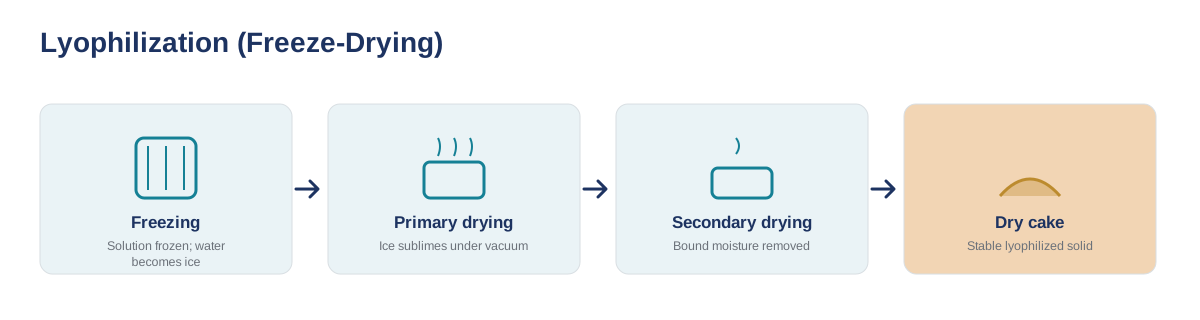
Freeze-drying stages that yield a stable lyophilized cake.
Why lyophilization matters for storage
Water is often what limits a material’s stability: many compounds degrade more readily in solution than as a dry solid. By removing water, lyophilization slows the processes that break material down, which typically improves shelf life. A dry, well-sealed lyophilized material is also easier to store and transport than a solution, because it is less dependent on being kept cold.
WHY HIGH TIDE'S PRODUCTS SHIP WITHOUT REFRIGERATION
Because the peptides supplied by High Tide Compounds are lyophilized, they do not require refrigeration during shipping. The dry, freeze-dried form is stable enough for transit at ambient temperature; storage recommendations for the longer term are covered in Storage Temperatures.
Reconstitution
Lyophilized material is dry by design, so in a research setting it is typically returned to solution before use — a step called reconstitution, in which an appropriate solvent is added back. Once reconstituted, a material is generally less stable than in its dry form, which is why dry storage and in-solution storage are treated differently (see Storage Best Practices). This article describes reconstitution only as a concept; it does not provide procedures or any instructions for use.
DEFINITION — RECONSTITUTION
Returning a lyophilized (dry) material to solution by adding an appropriate solvent before it is used in laboratory research.
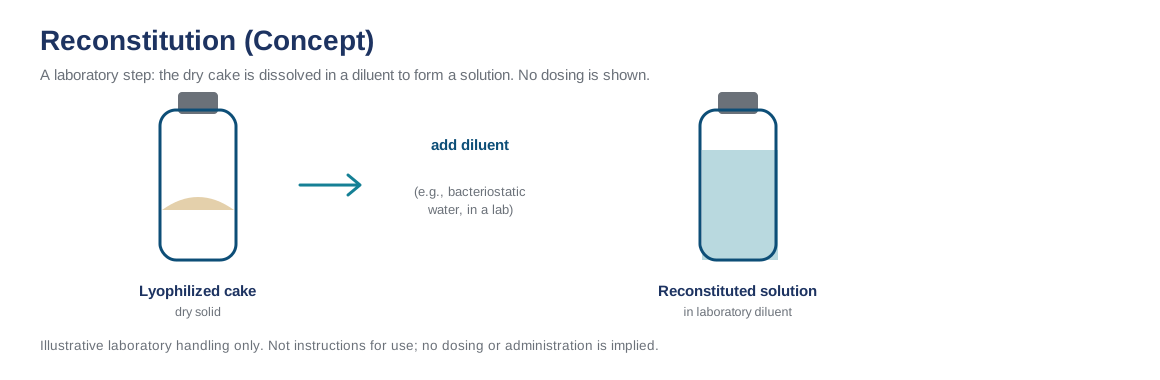
Dissolving the dry cake in a laboratory diluent, as a concept. No dosing is shown.
What the lyophilized form does and does not tell you
That a material is lyophilized speaks to its physical form and storage behavior — not to its identity, purity, or contamination status. A neatly freeze-dried cake can still be evaluated for what it is and how pure it is through the tests covered in the Quality & Testing cluster. Lyophilization is a storage and stability advantage, read alongside — not instead of — the quality documentation.
Frequently asked questions
It is freeze-drying: removing water from a frozen material by sublimation under vacuum, leaving a dry, stable solid without the material becoming liquid.
Removing water slows the processes that degrade material, so the dry form generally stores better and is less dependent on being kept cold than a solution.
No. The lyophilized form is stable enough to ship at ambient temperature. Longer-term storage recommendations are covered in Storage Temperatures.
Returning the dry, lyophilized material to solution by adding an appropriate solvent before it is used in research. Reconstituted material is generally less stable than the dry form.
Glossary terms
Company standard
Continue learning
- Storage Best Practices — how to store lyophilized versus reconstituted material.
- Storage Temperatures — general temperature ranges for dry and in-solution material.
- Moisture Protection — why keeping lyophilized material dry matters.
- Shipping Stability — why the dry form travels well.
Research Use Only
All materials referenced are for laboratory research purposes only and are not for human or veterinary use. This article is educational and does not provide medical advice, dosing, or instructions for use.