
Home › Academy › Quality & Testing › Identity Testing Explained
Quality & Testing
Identity Testing Explained
Is the material the compound it claims to be? How identity is established — and why it comes first.
Last updated: 2026-07-12 · ~8 minutes
On this page
Before any other quality question can be answered honestly, one has to be settled: is the material actually the compound it claims to be? That is what identity testing establishes. It is the quiet foundation beneath every purity figure and storage note on a certificate.
This article is conceptual and educational, written for laboratory and research contexts. It explains how identity is established, not how to use any material.
Key takeaways
- Identity answers whether a material is the compound it claims to be — not how much or how pure.
- Identity and purity are different questions: a sample can be pure but wrong, or correct but impure.
- Mass-based methods such as mass spectrometry support identity by matching measured mass to the expected compound.
- Identity testing is comparative and depends on a reference standard of the known compound.
- A confident identity result is necessary but not sufficient for overall quality.
What “identity” means
Identity answers a deceptively simple question: is this material actually the compound it claims to be? Not how much of it is present, not how pure it is — just whether the substance is what the label says. It is the first question any evaluation should settle, because every other measurement assumes you already know what you are measuring.
DEFINITION — IDENTITY
The determination that a material is the specific compound it is represented to be, based on characteristic properties measured against a known reference for that compound.
Identity versus purity
Identity and purity are the two most commonly confused concepts in quality documentation, and keeping them separate is essential. Identity asks what the material is; purity asks how much of the sample is that material versus other components. A sample can be highly pure yet be the wrong compound, or correctly identified yet contain meaningful impurities. They are different questions answered by different tests.
| Identity | Purity | |
|---|---|---|
| Question | Is it the right compound? | How much is the main component? |
| Typical basis | Characteristic properties (e.g., mass) | Separation and relative quantity |
| Common method | Mass spectrometry | HPLC (area percentage) |
| A good result means | It is what it claims to be | The main component dominates the sample |
| It does not tell you | How pure the sample is | Whether the compound is the right one |
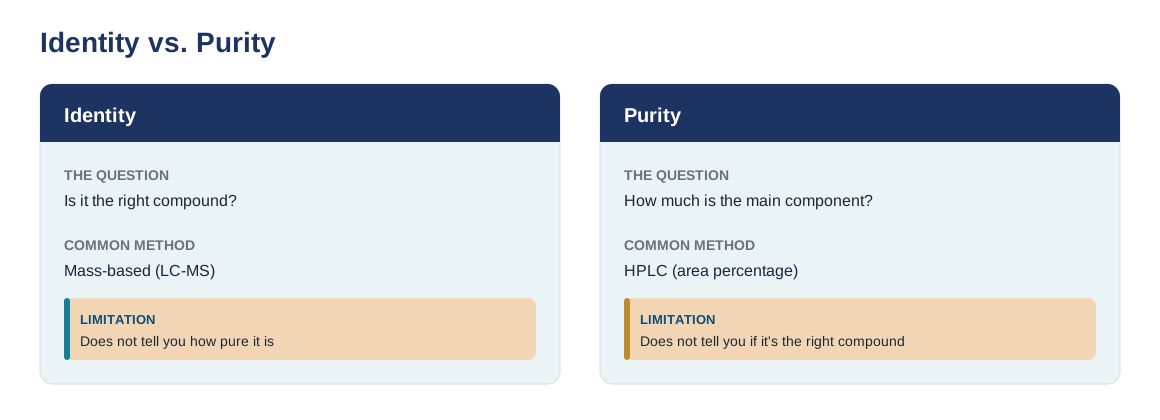
Identity asks what it is; purity asks how much of it is the target.
Why identity testing matters
Because identity underwrites everything else. A purity figure, a storage recommendation, a batch record — all of them presuppose that the material is correctly identified. If the identity is wrong, a beautiful purity result simply confirms that the sample is a very pure version of the wrong thing. Establishing identity first is what makes the rest of a certificate trustworthy.
General analytical approaches
Identity is established by measuring properties characteristic of a specific compound and comparing them against what is expected for that compound. Several techniques can contribute, and they are often used together to build confidence rather than relying on a single measurement. This article stays conceptual; the detailed method articles cover the instruments themselves.
Mass-based identification
A widely used approach relies on molecular mass. Mass spectrometry (MS) measures the mass-to-charge ratio of ions produced from a sample, which gives information about the molecular mass of the compound. If the measured mass matches the mass expected for the claimed compound, that supports the identity. For larger molecules such as peptides, mass information is particularly informative because it reflects the composition of the molecule. MS is frequently paired with a separation step (as in LC-MS) so that identity is assessed on a resolved component rather than a mixture.
RESEARCH NOTE — SUPPORTING, NOT SOLE, EVIDENCE
A matching mass strongly supports identity but is best read alongside other evidence. Different compounds can share a molecular mass, so identity is usually built from several consistent observations rather than one number.
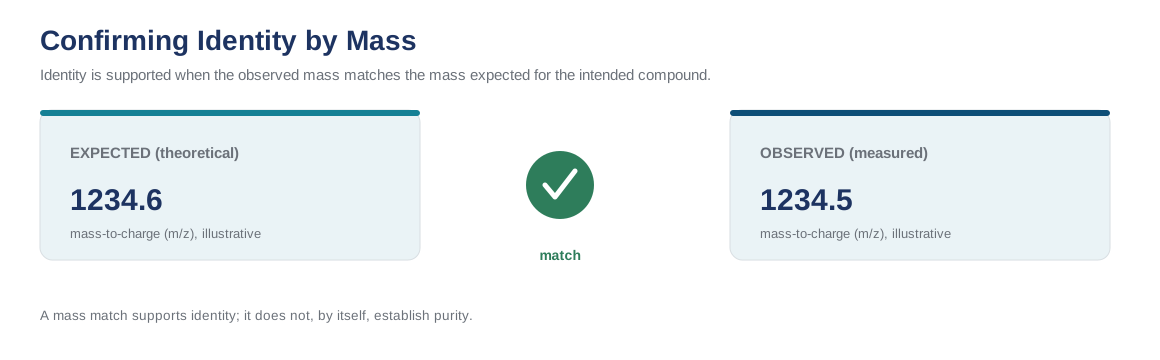
A match between expected and observed mass supports identity.
Reference standards
Identity testing is comparative: a measured property means little without something to compare it against. A reference standard — a well-characterized sample of the known compound — provides that basis. Comparing a sample’s behavior to a reference under the same conditions is what turns a raw measurement into an identity conclusion.
DEFINITION — REFERENCE STANDARD
A well-characterized material of known identity used as the comparison point against which a test sample’s properties are evaluated.
Limitations of identity testing
Identity testing confirms what a material is; it does not, on its own, tell you how pure it is, whether it is sterile, or what trace contaminants it may carry. Those are separate questions with separate tests. A confident identity result is necessary but not sufficient for an overall quality picture — it is the foundation, not the whole building.
How identity results appear on documentation
On a Certificate of Analysis, identity typically appears as a named test with a method (often mass spectrometry or LC-MS) and a result stated as a conformance — for example, that the measured mass is consistent with the expected compound. As with any result, read it alongside its method, and remember that it answers only the identity question, not purity or contamination.
Frequently asked questions
Identity asks whether the material is the right compound; purity asks how much of the sample is that compound. They are distinct questions answered by different tests.
It measures the mass-to-charge ratio of ions from the sample, giving molecular-mass information. A match to the expected mass supports the identity, especially when read alongside other evidence.
Identity is comparative. A well-characterized reference of the known compound provides the basis against which a sample’s measured properties are judged.
No. It confirms what the material is, not how pure or contaminant-free it is. Those require separate tests.
Glossary terms
Company standard
Continue learning
- Purity Testing Explained — the complementary question to identity.
- Understanding LC-MS — how separation plus mass analysis supports identity.
- Reading a Certificate of Analysis — where identity results appear and how to read them.
- Understanding COAs — how identity fits into the wider certificate.
Research Use Only
All materials referenced are for laboratory research purposes only and are not for human or veterinary use. This article is educational and does not provide medical advice, dosing, or instructions for use.