On this page
Documentation carries more weight when an outside party stands behind it. This page describes High Tide Compounds’ independent, third-party testing — what it covers, what it adds, and the specifics worth confirming directly.
The content is descriptive and educational, within a Research Use Only context.
Key takeaways
- High Tide Compounds supports its documentation with independent, third-party testing.
- Testing includes HPLC (supporting purity) and mass spectrometry (supporting identity).
- Every batch is tested and receives its own Certificate of Analysis.
- Independence adds an outside check but depends on the sample and chain of custody.
- Specific labs, accreditation, and custody procedures should be confirmed directly.
Independent testing at High Tide Compounds
High Tide Compounds supports its quality documentation with independent, third-party analytical testing. The role of independence is to add an outside check to the company’s quality claims — results that do not depend solely on the seller’s own assessment. Every batch is tested, and a Certificate of Analysis is generated and made available so customers can review the data themselves.
The methods used
The company’s independent testing includes High-Performance Liquid Chromatography (HPLC) and mass spectrometry (MS) — the pair that, respectively, support purity and identity. Because a peptide’s identity is tied to its molecular mass, mass-based analysis is particularly informative, while HPLC provides the separation behind a purity figure. The Understanding HPLC and Understanding LC-MS articles explain how these methods work.
| Method | Primarily supports |
|---|---|
| HPLC (High-Performance Liquid Chromatography) | Purity |
| Mass spectrometry (MS) | Identity / composition |
Testing every batch
Independence is paired with per-batch testing. Because batches are not assumed identical — the point of the Batch Consistency article — testing each one and issuing its own COA is what makes the documentation meaningful for the specific material a customer receives. A COA that can be matched to the batch in hand is the practical payoff.
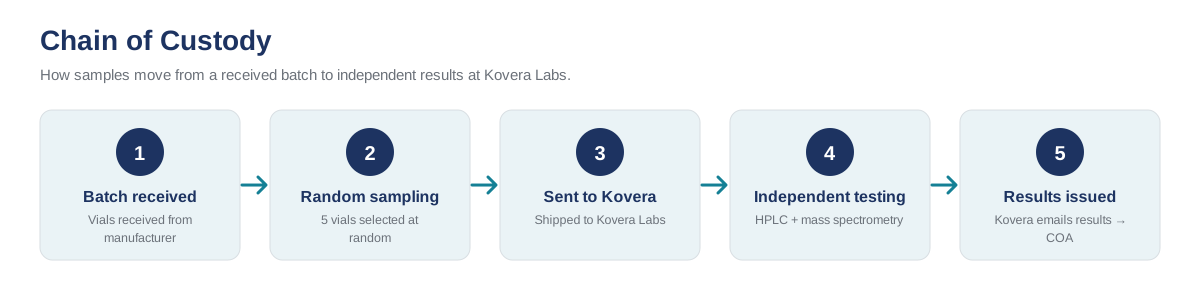
How samples move from a received batch to independent results.
What independent testing adds — and its limits
Independent testing strengthens confidence, but the Third-Party Testing article’s cautions apply here too: a result is only as good as the sample tested and the chain of custody behind it, and independence does not by itself replace sourcing, in-process controls, and documentation. High Tide Compounds treats independent testing as one important pillar within a broader quality system, not as a stand-alone guarantee.
Details to confirm
Some specifics of the company’s independent testing are best confirmed directly rather than stated in general educational content.
VERIFY WITH HIGH TIDE COMPOUNDS
The specific testing laboratory or laboratories, their accreditation status, and the exact sampling and chain-of-custody procedures are company details to confirm directly. This page describes the company’s independent-testing approach in general; for specifics, contact High Tide Compounds. [CONFIRM WITH HIGH TIDE COMPOUNDS]
How to see the results
The results of independent testing are published as Certificates of Analysis in the COA Library. Reviewing a COA for a specific batch — and matching it to the material received — is how a customer verifies the outcome of the testing described here. The Understanding COAs and Reading a COA articles walk through exactly how to do that.
Frequently asked questions
Independent, third-party analytical testing including HPLC (for purity) and mass spectrometry (for identity), with a Certificate of Analysis generated per batch.
Yes. Because batches are not assumed identical, each is tested and receives its own COA, available in the COA Library.
It adds a valuable outside check, but it depends on the sample and chain of custody and does not replace sourcing, controls, and documentation. It is one pillar of the quality system.
The specific laboratory, its accreditation, and custody procedures are best confirmed directly with High Tide Compounds.
Related articles
Company standard
Continue learning
- Third-Party Testing — what independence adds and depends on.
- Seven-Point Quality Program — the framework testing supports.
- Understanding HPLC and LC-MS — the methods used.
- Understanding COAs — where results are published.
Research Use Only
All materials referenced are for laboratory research purposes only and are not for human or veterinary use. This article is educational and does not provide medical advice, dosing, or instructions for use.