
Home › Academy › Quality & Testing › Understanding HPLC
Quality & Testing
Understanding HPLC
How High-Performance Liquid Chromatography separates a sample — and why it excels at purity.
Last updated: 2026-07-12 · ~8 minutes
On this page
Behind most purity figures on a research-material certificate sits a single technique: HPLC. Understanding what it does — and what it does not — makes those figures far easier to read with the right degree of confidence.
This article is conceptual and educational; it explains how HPLC works in principle, not as an operational laboratory procedure.
Key takeaways
- HPLC separates a mixture into its components so each can be measured.
- Separation arises from how components interact with the mobile and stationary phases.
- Components appear as peaks in a chromatogram, positioned by retention time.
- Peak area supports purity as an area percentage of the total.
- A matching retention time does not prove identity; that usually needs a reference or a mass-based method.
What HPLC is
HPLC stands for High-Performance Liquid Chromatography. At heart it is a separation technique: it takes a mixture and pulls it apart into its individual components so each can be seen and measured. Because most real samples are mixtures — a main compound plus smaller amounts of other things — separating them is the first step toward saying anything precise about purity.
DEFINITION — HPLC
High-Performance Liquid Chromatography: a technique that separates the components of a liquid sample by passing it through a column, so each component can be detected and measured.
The separation principle
Separation in HPLC works because different components interact differently with two “phases.” The mobile phase is a liquid solvent that carries the sample; the stationary phase is a material packed inside the column that the sample flows past. Components that interact strongly with the stationary phase move slowly; those that interact weakly move quickly. That difference in speed is what spreads the components apart as they travel through the column.
| Element | Role |
|---|---|
| Mobile phase | The liquid solvent that carries the sample through the system. |
| Stationary phase | The material in the column that components interact with. |
| Column | Where separation happens, packed with the stationary phase. |
| Detector | Registers each component as it emerges from the column. |
Retention time, peaks, and chromatograms
As each separated component leaves the column, the detector responds, and that response is recorded over time to produce a chromatogram. Each component appears as a peak. The time it takes a component to travel through the system is its retention time — a characteristic that, under fixed conditions, tends to be reproducible for a given component. The main compound typically produces the dominant peak; impurities appear as additional peaks at their own retention times.
DEFINITION — RETENTION TIME
The time a component takes to pass through the chromatographic system under set conditions, appearing as the position of its peak in the chromatogram.
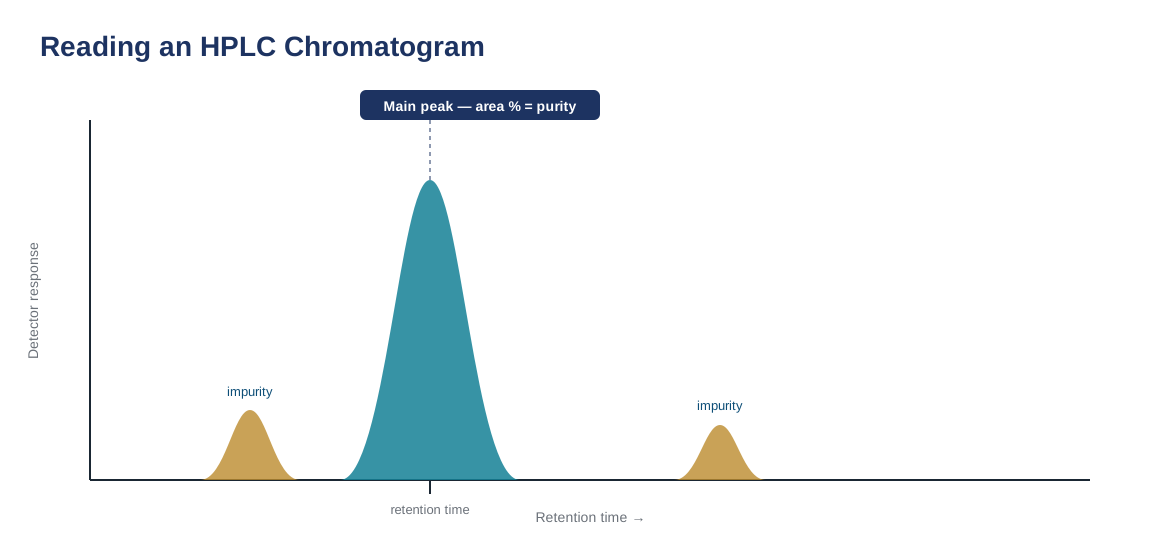
How a purity peak is read on an HPLC chromatogram.
Peak area and purity applications
The size of a peak — specifically its area — relates to how much of that component is present. By comparing the main component’s peak area to the total area of all peaks, an area-percentage purity can be estimated. This is why HPLC is so widely used for purity: it both separates the components and provides a basis for quantifying the main one relative to the rest. The dedicated Purity Testing article covers how that figure is read.
Limitations
HPLC is powerful but has boundaries. It can only report what it detects: components below the detection limit do not appear, and if two components are not fully separated, one can hide beneath another. Area percentage also assumes components respond comparably to the detector, which is not always exactly true. These limits are why a purity figure is always tied to its method and conditions.
Why HPLC alone may not establish identity
A common misconception is that a matching retention time proves identity. It does not, on its own. Retention time is characteristic but not unique — different compounds can share similar retention times, and retention can shift with conditions. HPLC is excellent at separation and purity, but confirming what a component is usually calls for additional evidence, such as comparison against a reference standard or a mass-based method. This is precisely where LC-MS comes in — pairing HPLC’s separation with mass analysis to support identity.
Frequently asked questions
It separates the components of a liquid sample by passing it through a column, so each component emerges at a different time and can be detected and measured.
The time a component takes to travel through the system under set conditions. It positions the component’s peak in the chromatogram and is characteristic but not unique.
By comparing the main component’s peak area to the total area of all peaks, giving an area-percentage purity under the method used.
Not reliably. Retention time is characteristic but not unique, so identity usually requires a reference standard or a mass-based method such as LC-MS.
Related articles
Company standard
Continue learning
- Purity Testing Explained — how the HPLC area percentage is read.
- Understanding LC-MS — adding mass analysis to support identity.
- Identity Testing Explained — why separation alone is not identification.
- Reading a Certificate of Analysis — where HPLC results appear.
Research Use Only
All materials referenced are for laboratory research purposes only and are not for human or veterinary use. This article is educational and does not provide medical advice, dosing, or instructions for use.