
Home › Academy › Storage & Handling › Storage Temperatures
Storage & Handling
Storage Temperatures
Room, refrigerated, frozen — and why the lyophilized form is more temperature-tolerant than a solution.
Last updated: 2026-07-12 · ~7 minutes
On this page
How cold does research material need to be kept? The honest answer is: it depends on the form and the timeframe. This article maps the common temperature ranges and explains why a lyophilized compound and a reconstituted one can have quite different temperature needs.
The content is general and educational, for laboratory and research contexts only; exact figures for a given product belong on the product page.
Key takeaways
- Lower temperatures generally slow degradation, so long-term storage often favors cooler conditions.
- Common ranges are ambient, refrigerated, frozen, and deep-frozen.
- Lyophilized material is comparatively temperature-tolerant — it ships without refrigeration.
- Shipping condition and long-term storage recommendation are two different questions.
- Reconstituted material is usually more temperature-sensitive; minimize freeze-thaw cycling.
Temperature as a storage lever
Temperature is one of the main levers for preserving a material over time. In general, lower temperatures slow the chemical and physical processes that degrade material, which is why long-term storage often favors cooler conditions. But “colder is slower” is a general tendency, not an absolute rule for every material, and for lyophilized compounds the practical picture is more forgiving than many people expect.
Common temperature ranges
Laboratory storage tends to cluster around a few familiar ranges. The table describes them in general terms; it is orientation, not a directive for any specific product.
| Range (general) | Typical description | General use |
|---|---|---|
| Ambient / room temperature | Around normal indoor conditions | Short-term dry storage; transit of stable dry forms |
| Refrigerated | Cool, above freezing (commonly ~2–8 °C) | Longer-term storage of many materials |
| Frozen | Below freezing (e.g., ~ −20 °C) | Extended long-term storage |
| Deep frozen | Much colder (e.g., ~ −80 °C) | Long-term storage of especially sensitive material |
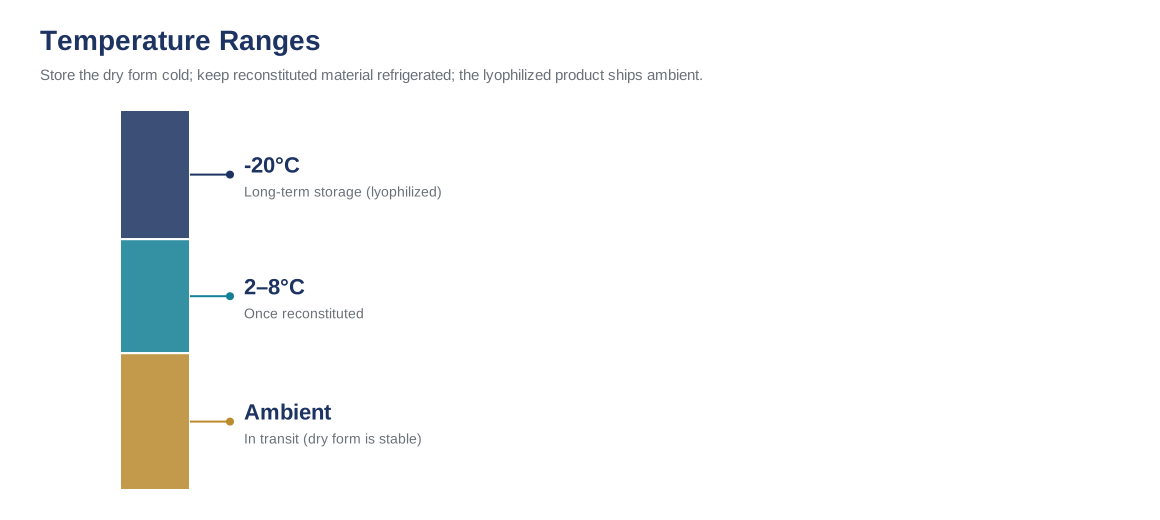
General storage ranges for dry, reconstituted, and in-transit material.
Lyophilized material is comparatively forgiving
Because lyophilization removes the water that drives much degradation, the dry form is generally more tolerant of temperature than a solution would be. This is why lyophilized peptides do not require refrigeration to survive shipping. For longer-term storage, cooler conditions typically help preserve the dry material further, but the material is not fragile in the way an in-solution form might be.
SHIPPING VS. LONG-TERM STORAGE
These are two different questions. For shipping, the lyophilized form is stable at ambient temperature — no cold chain required. For long-term storage, cooler conditions generally extend shelf life. Do not confuse a transit condition with a long-term storage recommendation.
Reconstituted material and temperature
Once material is reconstituted into solution, temperature usually matters more. In-solution forms are generally less stable and are commonly kept cold and used within a limited window. The contrast with the dry form is the practical takeaway: the same compound can be relatively temperature-tolerant when lyophilized and more temperature-sensitive once dissolved.
Freeze-thaw cycling
For material kept frozen, repeated freezing and thawing can be more stressful than steady storage. Each freeze-thaw cycle is an opportunity for change, so minimizing unnecessary cycling is a common precaution. Where material will be used in portions, planning to limit how often it is thawed and refrozen is generally sensible.
DEFINITION — FREEZE-THAW CYCLE
One round of freezing a material and then thawing it. Repeated cycles can stress some materials more than continuous storage at a stable temperature.
Follow the product page for specifics
This article gives the general landscape; it deliberately avoids prescribing an exact temperature for any particular compound. Recommended storage for a specific product should come from that product’s page and documentation. Where a precise figure is required and not yet confirmed, it is treated as a company fact to confirm rather than assumed.
VERIFY PRODUCT-SPECIFIC STORAGE
Exact storage temperatures for a given product are product-specific. Use the product page and documentation; where not yet stated, [CONFIRM WITH HIGH TIDE COMPOUNDS].
Frequently asked questions
No. The dry, freeze-dried form is stable at ambient temperature for shipping. Cooler conditions are a long-term storage consideration, not a shipping requirement.
Lower temperatures generally slow degradation, but it is a tendency rather than an absolute rule, and the lyophilized form is fairly forgiving. Follow the product’s stated storage guidance.
In solution, material is generally less stable, so it is commonly kept cold and used within a limited window — unlike the more tolerant dry form.
One round of freezing then thawing. Repeated cycles can stress some materials more than steady storage, so unnecessary cycling is usually avoided.
Glossary terms
Company standard
Continue learning
- What Is Lyophilization? — why the dry form tolerates temperature.
- Storage Best Practices — the full set of storage variables.
- Shipping Stability — why ambient transit works for dry material.
- Cold Chain Basics — what cold chain is, and why it isn’t needed here.
Research Use Only
All materials referenced are for laboratory research purposes only and are not for human or veterinary use. This article is educational and does not provide medical advice, dosing, or instructions for use.