
Home › Academy › Storage & Handling › Cold Chain Basics
Storage & Handling
Cold Chain Basics
What a cold chain is, when it's essential — and why lyophilized products don't require one.
Last updated: 2026-07-12 · ~6 minutes
On this page
Cold chain is a phrase that sounds essential for anything shipped in the life sciences — which makes it worth understanding precisely, because for lyophilized products it is background rather than requirement. Knowing what a cold chain is makes it clear why these products don’t need one.
This article is general and educational, for laboratory and research contexts only.
Key takeaways
- A cold chain is an unbroken, temperature-controlled supply chain from origin to destination.
- It exists for materials whose stability depends on staying cold during transit.
- It involves controlled packaging, refrigerated handling, and monitoring — with no gaps.
- Lyophilized peptides don’t require a cold chain; the dry form ships at ambient temperature.
- Reconstituted material is a separate, after-receipt handling question.
What a cold chain is
A cold chain is a temperature-controlled supply chain: an unbroken sequence of refrigerated or frozen conditions maintained from origin to destination, so that a temperature-sensitive material is never allowed to warm beyond a defined range. The word “chain” is deliberate — the protection is only as strong as its weakest link, and a single gap can undermine the whole effort.
DEFINITION — COLD CHAIN
A supply chain that keeps a material within a controlled low-temperature range at every step from origin to destination, without interruption.
Why some materials need one
Cold chains exist for materials whose stability depends on staying cold — typically things that degrade meaningfully at ambient temperature over the time it takes to ship them. For such materials, warming during transit is not a cosmetic issue but a real loss of integrity, so the extra cost and complexity of temperature control is justified. The need is a property of the material, not a universal requirement.
How a cold chain works, conceptually
Maintaining a cold chain generally involves temperature-controlled packaging (such as insulated containers with coolants), refrigerated handling and transport, and often monitoring to confirm the temperature stayed in range throughout. Each handoff — warehouse, carrier, destination — has to preserve the conditions. This overview stays conceptual; the point is the principle of unbroken control, not operational specifics.
| Element | Role in a cold chain |
|---|---|
| Temperature-controlled packaging | Keeps material cold during transit (e.g., insulation and coolants). |
| Refrigerated handling/transport | Maintains conditions between steps. |
| Monitoring | Confirms the temperature stayed within range. |
| Unbroken handoffs | Every transfer preserves the controlled conditions. |
Why lyophilized peptides generally do not need a cold chain
Here is the practical payoff of understanding the concept: it explains what High Tide Compounds’ products do not require. Because the peptides are lyophilized, the water that drives ambient-temperature degradation has been removed, and the dry form tolerates ordinary shipping conditions. That is precisely why these products ship at ambient temperature, without the refrigerated packaging and monitoring a cold chain entails. Cold chain is useful background for understanding shipping in general — and, for the lyophilized form, background rather than requirement.
FOR HIGH TIDE'S PRODUCTS
High Tide Compounds’ lyophilized peptides do not require a cold chain. They ship at ambient temperature because the dry form is stable enough for transit. This article explains cold chain as general background, not as something these products need.
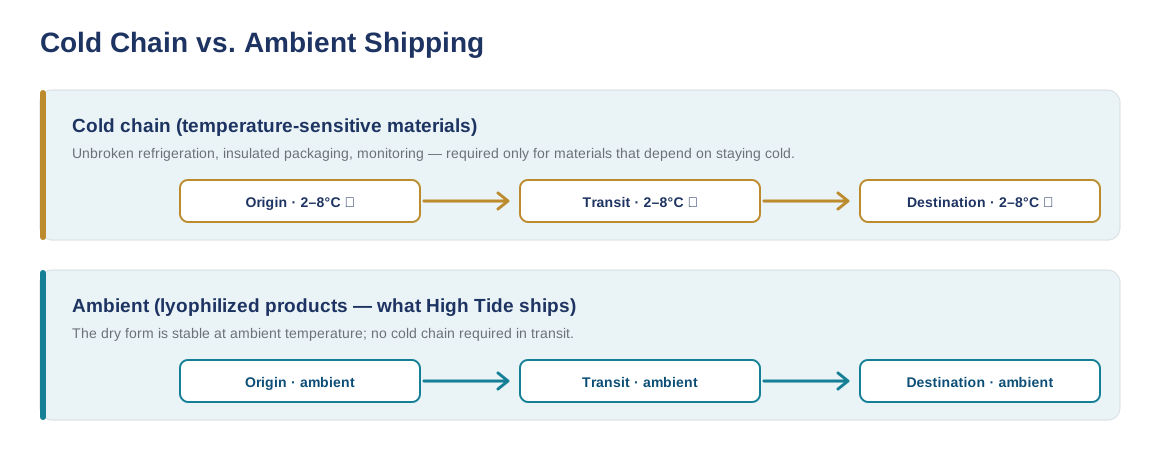
The lyophilized dry form ships ambient; cold chain applies once reconstituted.
The reconstituted exception
The dry form’s independence from cold chain does not necessarily extend to material once it has been reconstituted. In solution, a material is generally less stable and may call for cold handling and prompt use — a storage-and-handling matter after receipt rather than a shipping one. The cold-chain question and the after-reconstitution question are distinct, and only the latter tends to involve keeping material cold for these products.
Putting cold chain in context
Cold chain is one of those concepts that is most useful for clarifying what is not needed. For temperature-sensitive materials it is essential; for a stable, lyophilized dry form shipped promptly, it is unnecessary. Understanding the idea lets a reader see why ambient shipping is appropriate here rather than a shortcut — the material simply does not depend on the cold that a chain would maintain.
Frequently asked questions
A supply chain that keeps a material within a controlled low-temperature range at every step from origin to destination, without interruption.
No. Because they are lyophilized, they ship at ambient temperature. The dry form is stable enough for transit, so a cold chain isn’t required.
Because their stability depends on staying cold; they would degrade meaningfully at ambient temperature over the shipping window. That need is a property of the material.
Not necessarily. In solution, material is generally less stable and may need cold handling and prompt use — a storage matter after receipt, separate from shipping.
Related articles
Company standard
Continue learning
- Shipping Stability — why ambient transit works for the dry form.
- Storage Temperatures — general ranges and the transit-vs-storage distinction.
- What Is Lyophilization? — why the dry form is temperature-tolerant.
- Storage Best Practices — handling material after it arrives.
Research Use Only
All materials referenced are for laboratory research purposes only and are not for human or veterinary use. This article is educational and does not provide medical advice, dosing, or instructions for use.