
Home › Academy › Quality & Testing › Endotoxin Testing Explained
Quality & Testing
Endotoxin Testing Explained
Why a sterile material can still carry endotoxins — and why it is a separate test.
Last updated: 2026-07-12 · ~7 minutes
On this page
One of the most useful facts in quality documentation is also one of the least intuitive: a material can be sterile and still carry endotoxins. Endotoxin testing exists precisely because killing bacteria and removing their molecular residue are two different things.
This article is conceptual and educational, for laboratory and research contexts only.
Key takeaways
- Endotoxins are lipopolysaccharide (LPS) components of gram-negative bacterial cell walls — molecules, not organisms.
- They can persist after bacteria are no longer viable, so sterile does not mean endotoxin-free.
- Sterility and endotoxin are separate, complementary tests that cannot substitute for one another.
- Endotoxin is reported as a quantity in endotoxin units (e.g., EU/mL) against a limit.
- A low endotoxin result answers only the endotoxin question, not purity, identity, or metals.
What endotoxins are
Endotoxins are components of the outer cell wall of certain bacteria — specifically the lipopolysaccharide (LPS) found in gram-negative bacteria. They are not organisms themselves but molecular fragments associated with those organisms. This distinction is the key to the whole subject: because endotoxins are structural molecules, they can remain in a material even after the bacteria they came from are no longer alive.
DEFINITION — ENDOTOXIN
A lipopolysaccharide (LPS) component of the outer cell wall of gram-negative bacteria that can persist in a material independently of whether viable bacteria remain.
Endotoxin versus living microbial contamination
It is tempting to assume that if a material is sterile, it must be endotoxin-free. That assumption is wrong, and understanding why is the point of endotoxin testing. Sterility concerns viable organisms — whether anything is alive and able to grow. Endotoxin concerns molecular residue that can remain behind after organisms have died. A process that kills bacteria does not necessarily remove the endotoxin molecules they leave, so a sterile sample can still carry endotoxins.
Why sterility and endotoxin are separate tests
Because they measure different things, sterility and endotoxin testing cannot substitute for one another. Sterility looks for growth; endotoxin testing looks for a specific class of molecule. A material may pass one and not the other. Treating them as a single check is a common misunderstanding — they are complementary, each answering a question the other does not.
| Sterility testing | Endotoxin testing | |
|---|---|---|
| Detects | Viable microorganisms (growth) | Endotoxin molecules (LPS) |
| Depends on organisms being | Alive | Not required to be alive |
| A passing result means | No growth observed | Endotoxin below the limit |
| Does not tell you | Endotoxin levels | Whether organisms are viable |
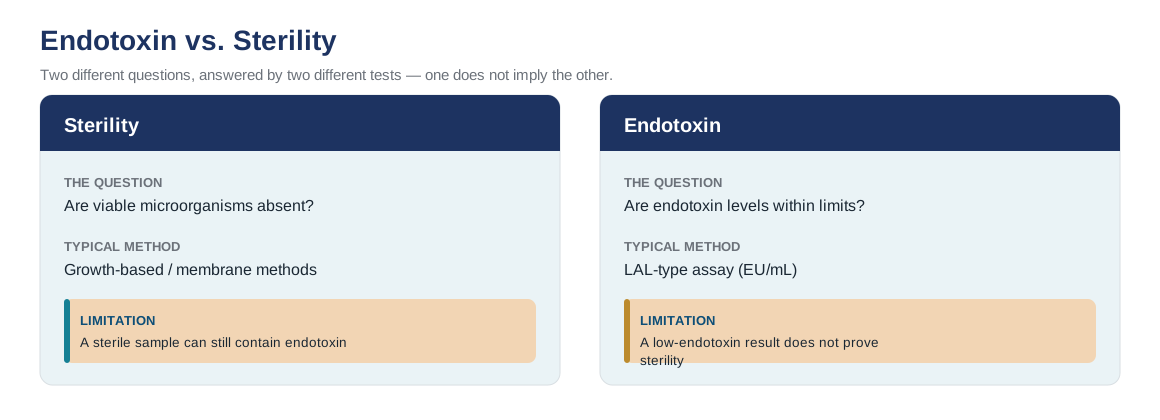
Sterility and endotoxin are separate questions with separate limits.
General testing concepts
Endotoxin testing conceptually relies on a reaction that responds to the presence of endotoxin, allowing the amount present to be estimated. The result is a measured level rather than a simple yes/no, which is why endotoxin results are reported as a value against a limit. As with other tests, this article keeps to the concept rather than an operational procedure.
Result units and limits
Endotoxin is quantified in endotoxin units, commonly expressed per volume or per mass — for example, EU/mL or EU/mg. A specification sets a limit that the measured value must fall under. Because endotoxin is reported as a quantity, the meaningful comparison is the measured level against its limit, not the presence or absence of any signal at all.
DEFINITION — ENDOTOXIN UNIT (EU)
A standardized unit expressing the amount of endotoxin present, typically reported per volume or mass (e.g., EU/mL or EU/mg) and compared against a defined limit.
Detection limits and interpretation
Every method has a detection limit — a level below which endotoxin cannot be reliably measured. A result is interpreted relative to both that limit and the specification. As with any single test, an endotoxin result answers only its own question. A low endotoxin level does not establish sterility, chemical purity, identity, or heavy-metal content; those remain separate determinations.
How endotoxin results appear on documentation
On a Certificate of Analysis, endotoxin typically appears as a named test with a measured value in endotoxin units and a specification limit. Read it as you would any result — value, unit, specification — and remember that it complements, rather than replaces, the sterility result alongside it.
Frequently asked questions
A lipopolysaccharide component of the outer cell wall of gram-negative bacteria. It is a molecule associated with those bacteria, not a living organism.
Not necessarily. Endotoxins can remain even after the bacteria that produced them are no longer viable, which is why endotoxin testing is separate from sterility testing.
As a measured quantity in endotoxin units, commonly per volume or mass (EU/mL or EU/mg), compared against a specification limit.
No. It answers the endotoxin question only. Sterility, purity, identity, and heavy metals are separate determinations.
Related articles
Glossary terms
Company standard
Continue learning
- Sterility Testing Explained — the complementary microbial-growth question.
- Heavy Metal Testing Explained — another contamination attribute.
- Understanding COAs — how endotoxin results appear on a certificate.
- Seven-Point Quality Program — how these tests fit together.
Research Use Only
All materials referenced are for laboratory research purposes only and are not for human or veterinary use. This article is educational and does not provide medical advice, dosing, or instructions for use.