
Home › Academy › Quality & Testing › Sterility Testing Explained
Quality & Testing
Sterility Testing Explained
A microbiological question, not a chemical one: what sterility testing shows, and its limits.
Last updated: 2026-07-12 · ~8 minutes
On this page
Chemical tests like purity and identity can look thorough while missing something entirely non-chemical: living contamination. Sterility testing addresses that separate concern — whether viable microorganisms are present — and it works in a fundamentally different way from the tests around it.
This article is conceptual and educational, written for laboratory and research contexts. It describes what sterility testing evaluates, not how to perform it and not any use of material.
Key takeaways
- Sterility testing is microbiological: it asks whether viable microorganisms are absent.
- It differs from purity, which is chemical; a pure sample can still be contaminated.
- The general approach is incubation followed by growth detection, so results take time.
- Testing examines a sample, not every unit, so results support an inference about the batch.
- A sterility result speaks only to microbial growth — not to purity, identity, endotoxins, or metals.
What sterility testing evaluates
Sterility testing asks a microbiological question: is the material free of viable microorganisms — bacteria, fungi, and similar organisms capable of growing? It is fundamentally different from the chemical questions asked by identity and purity. A sample can be chemically pure and still carry microbial contamination, because purity methods measure chemical composition, not living organisms.
DEFINITION — STERILITY
The absence of viable (living, capable-of-growing) microorganisms in a material, as assessed by a defined test method.
Why sterility and purity are different questions
Purity and sterility are measured by different means and answer different concerns. Purity is assessed by separating a sample and quantifying its chemical components; sterility is assessed by giving any microorganisms present the opportunity to grow and then looking for that growth. A high purity result says nothing about microbial contamination, and a sterility result says nothing about chemical purity. In a research setting, contamination can compromise experiments regardless of how chemically pure a material is.
| Purity | Sterility | |
|---|---|---|
| Question | How much is the main component? | Are viable microorganisms absent? |
| Domain | Chemical composition | Microbiological |
| General approach | Separation and measurement | Incubation and growth detection |
| Silent about | Microbial contamination | Chemical purity |
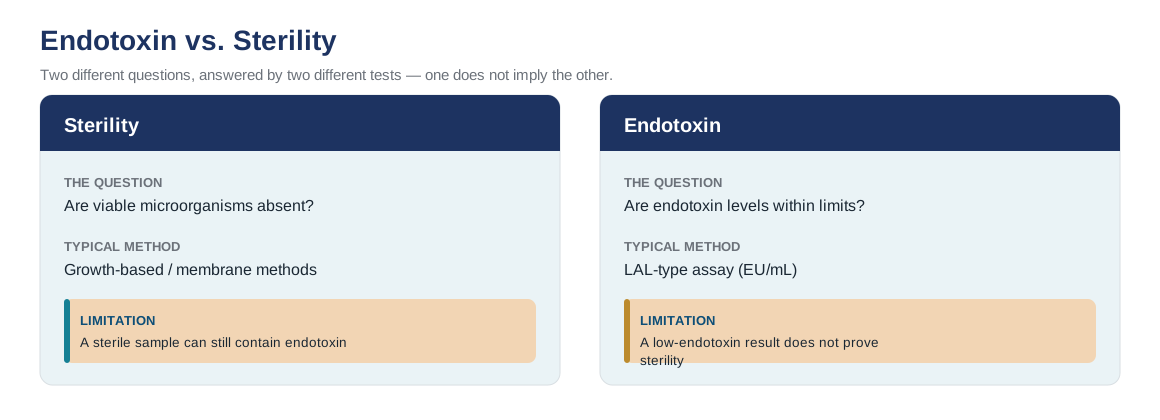
Sterility and endotoxin are separate questions with separate limits.
The general laboratory approach
Conceptually, sterility testing exposes a sample (or portions of it) to conditions that encourage microbial growth, typically by introducing it into a nutrient medium and holding it under favorable conditions for a period of time. If viable organisms are present, they multiply; if the medium remains clear with no signs of growth over the incubation period, that supports a conclusion of sterility. This article stays at the conceptual level and does not describe an operational protocol.
Incubation and growth detection
Two ideas are central. Incubation means holding the sample under conditions (temperature, time, medium) that favor growth, so that even small numbers of organisms have a chance to multiply to a detectable level. Growth detection is how that multiplication is observed — commonly as visible turbidity or other signs that organisms have proliferated. Because organisms need time to grow, sterility testing is not instantaneous.
DEFINITION — INCUBATION
Holding a sample under controlled conditions favorable to microbial growth for a defined period, so that any viable organisms present can multiply to a detectable level.
Sampling limitations
A crucial limitation: sterility testing examines a sample, not every unit in a batch. Because testing a portion consumes it, no test can directly confirm that every individual unit is sterile. Instead, results support an inference about the batch based on the sample examined. This is a statistical relationship, and it is why sterility results are best understood as strong supporting evidence rather than an absolute, unit-by-unit guarantee.
Testing timelines
Because the method depends on giving organisms time to grow, sterility testing typically spans a defined incubation period rather than producing an immediate reading. The timeline is a feature of the biology, not a delay to be engineered away — rushing incubation would undermine the test’s ability to detect slow-growing organisms.
What a sterility result can and cannot establish
A sterility result supports the conclusion that the sample tested showed no viable microbial growth under the conditions used. It does not, by itself, establish chemical purity, identity, endotoxin levels, or heavy-metal content — each of those is a separate test. Nor does it guarantee that every unit in a batch is identical to the sample. Read a sterility result as a specific answer to the microbial-growth question.
RESEARCH CONTEXT — NOT A HUMAN-USE STATEMENT
Sterility is relevant in laboratory research where microbial contamination could compromise experimental results. Referencing sterility here is about laboratory suitability and documentation — it does not imply that any material is intended for human or veterinary use.
Frequently asked questions
Purity is a chemical measure of how much of a sample is the intended component. Sterility is a microbiological measure of whether viable organisms are absent. They are separate questions with separate methods.
It relies on giving any organisms present the chance to grow to a detectable level during an incubation period. That biological timeline cannot be safely shortened without reducing the test’s sensitivity.
No. Testing examines a sample and supports an inference about the batch. It is strong evidence, not a unit-by-unit guarantee.
Not necessarily. Endotoxins can persist even where organisms are no longer viable, so endotoxin testing is a separate check.
Related articles
Glossary terms
Company standard
Continue learning
- Endotoxin Testing Explained — why sterile does not mean endotoxin-free.
- Purity Testing Explained — the chemical question sterility does not address.
- Batch Consistency — why each batch is tested individually.
- Understanding COAs — how sterility results appear on documentation.
Research Use Only
All materials referenced are for laboratory research purposes only and are not for human or veterinary use. This article is educational and does not provide medical advice, dosing, or instructions for use.