
Home › Academy › Quality & Testing › Net Content Verification
Quality & Testing
Net Content Verification
A question of amount, not composition: measured quantity versus the labeled amount.
Last updated: 2026-07-12 · ~6 minutes
On this page
Amid tests for identity, purity, and contamination, one simple question is easy to overlook: is the labeled amount of material actually there? Net content verification answers it — a check of quantity that is distinct from every question about composition.
This article is conceptual and educational, for laboratory and research contexts only.
Key takeaways
- Net content is how much material is present, verified against the labeled amount.
- It is a question of quantity, not composition — fundamentally different from purity.
- A pure sample can still contain less than labeled, and vice versa.
- Results are judged against a tolerance that accounts for measurement uncertainty.
- Net content is recorded per batch and read as amount, distinct from the purity figure.
What net content means
Net content is simply how much material is actually present — the quantity in a container, independent of what it is or how pure it is. If a vial is labeled as containing a certain amount, net content verification checks whether the measured quantity matches that label. It answers a question of amount, not composition.
DEFINITION — NET CONTENT
The measured quantity of material actually present in a container, verified against the amount stated on the label.
Labeled amount versus measured content
A label states an intended quantity; verification measures the actual quantity. The two should agree within a reasonable tolerance, but they are conceptually distinct: one is a claim, the other a measurement. Net content verification is the step that connects the two, confirming that what the label says corresponds to what is in the container.
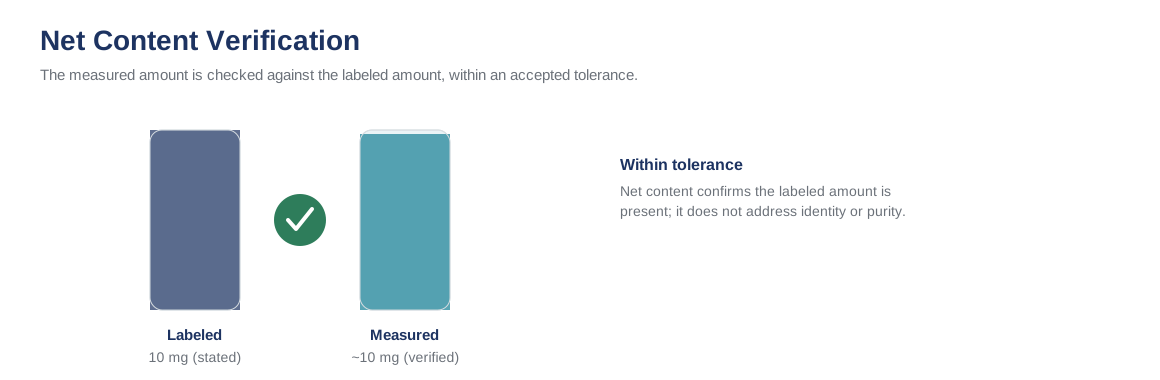
The measured amount checked against the labeled amount, within tolerance.
Why net content differs from purity
This is the distinction most worth internalizing. Purity is a proportion — how much of the sample is the intended component. Net content is an amount — how much material is present in total. A vial can be highly pure and contain less material than labeled, or contain the full labeled quantity at lower purity. Because they measure different things, a purity result tells you nothing about net content, and vice versa.
| Net content | Purity | |
|---|---|---|
| Question | How much material is present? | What proportion is the main component? |
| Type of measure | Quantity (e.g., mass) | Proportion (e.g., %) |
| Compared against | The labeled amount | A purity specification |
| Silent about | Composition and purity | Total quantity present |
Measurement uncertainty
No measurement is infinitely precise. Every quantity determination carries some uncertainty, and net content is judged against a tolerance rather than an exact target. A result close to — but not identical to — the labeled amount can still conform, provided it falls within the accepted range. Understanding tolerance prevents over-reading small, expected variations as problems.
DEFINITION — MEASUREMENT UNCERTAINTY
The range within which a measured value is expected to fall, reflecting the limits of the measurement. Net content is evaluated against a tolerance that accounts for this.
Sampling and test methods
Verifying net content involves measuring the quantity present, typically by a quantitative method appropriate to the material and its form. As with other tests, results reflect the sample or units examined. Because measuring can consume material, verification often relies on representative units rather than every container, supporting an inference about the batch.
Batch documentation
Net content, like the other quality attributes, is recorded per batch. Documenting the measured quantity against the labeled amount for a given lot keeps the record specific and traceable, consistent with the batch-by-batch approach used across the quality system.
How net content appears on documentation
On a Certificate of Analysis, net content typically appears as a measured quantity with a unit, checked against the labeled amount and a tolerance. Read it as amount, distinct from the purity figure elsewhere on the same document — the two answer different questions and should not be conflated.
Frequently asked questions
The measured quantity of material actually present in a container, checked against the amount stated on the label.
Net content is an amount (how much is present); purity is a proportion (how much is the main component). They measure different things and do not imply each other.
All measurement carries some uncertainty, so net content is evaluated against a tolerance. A value within that range conforms even if it isn’t identical to the label.
As a measured quantity with a unit, checked against the labeled amount and tolerance — separate from the purity result.
Related articles
Glossary terms
Company standard
Continue learning
- Purity Testing Explained — the composition question net content is often confused with.
- Reading a Certificate of Analysis — reading amount versus proportion.
- Batch Consistency — why each batch is documented individually.
- Understanding COAs — where net content sits on a certificate.
Research Use Only
All materials referenced are for laboratory research purposes only and are not for human or veterinary use. This article is educational and does not provide medical advice, dosing, or instructions for use.