
Home › Academy › Quality & Testing › Purity Testing Explained
Quality & Testing
Purity Testing Explained
What a purity percentage really measures, how area percentage works, and what it leaves unanswered.
Last updated: 2026-07-12 · ~8 minutes
On this page
“99% pure” is one of the most quoted phrases in research-material documentation and one of the least examined. This article looks at what a purity result actually measures, how it is produced, and — importantly — the questions it does not answer.
The content is conceptual and educational, for laboratory and research contexts only.
Key takeaways
- Purity is a relative measure of how much of a sample is the intended component.
- It is established by separation: components emerge as distinct peaks, and impurities appear as additional peaks.
- Area percentage compares the main peak’s area to the total; it is standardized but carries assumptions.
- A purity result is tied to its method and detection limit — it cannot report what it cannot detect.
- High purity answers the purity question only; identity, sterility, endotoxin, and heavy-metal questions are separate.
What purity means analytically
Purity describes how much of a sample is the intended component versus everything else. In analytical terms it is usually a relative measure: not an absolute count of molecules, but a proportion derived from separating a sample into its components and comparing their signals. When a certificate reports a compound as “99% pure,” it is making a statement about that proportion under a specific method, not a philosophical claim of perfection.
DEFINITION — PURITY
A measure of the proportion of a sample that consists of the intended component, typically determined by separating the sample and comparing the main component’s signal to the total.
Purity versus identity
It is worth restating the distinction, because the two are so often collapsed. Identity asks whether the material is the right compound; purity asks how much of the sample that compound represents. A high purity result on a misidentified compound tells you that you have a very pure sample of the wrong thing. Purity is only meaningful once identity is established.
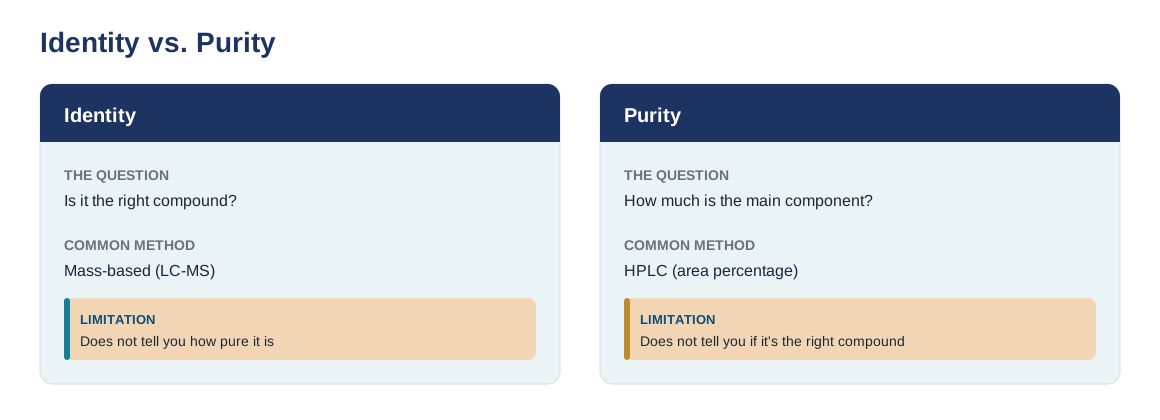
Identity asks what it is; purity asks how much of it is the target.
How impurities become detectable
Purity testing works by separation. When a sample is passed through a chromatographic system, its components travel at different rates and emerge at different times, producing distinct peaks in a chromatogram. The main component appears as the dominant peak; impurities show up as additional, usually smaller peaks. What is “detectable” depends on the method: components present below a method’s detection limit will not appear, which is one reason a purity result is tied to its method.
DEFINITION — CHROMATOGRAM
A plot produced by a chromatographic separation showing detector response over time; each peak corresponds to a component emerging from the system.
Area percentage
A common way to express purity is area percentage. The detector response for each peak has an area, and the main component’s area is compared to the total area of all peaks. If the main peak accounts for 99% of the total area, the result may be reported as 99% area purity. This is a relative measure and carries assumptions — for instance, that components respond similarly to the detector — so it is a strong, standardized indicator rather than an absolute truth.
| Term | Meaning |
|---|---|
| Peak | A signal from one component emerging from the separation. |
| Peak area | The integrated detector response for that peak. |
| Area percentage | One peak’s area as a percentage of the total area of all peaks. |
| Detection limit | The smallest amount a method can reliably detect; below it, nothing is reported. |
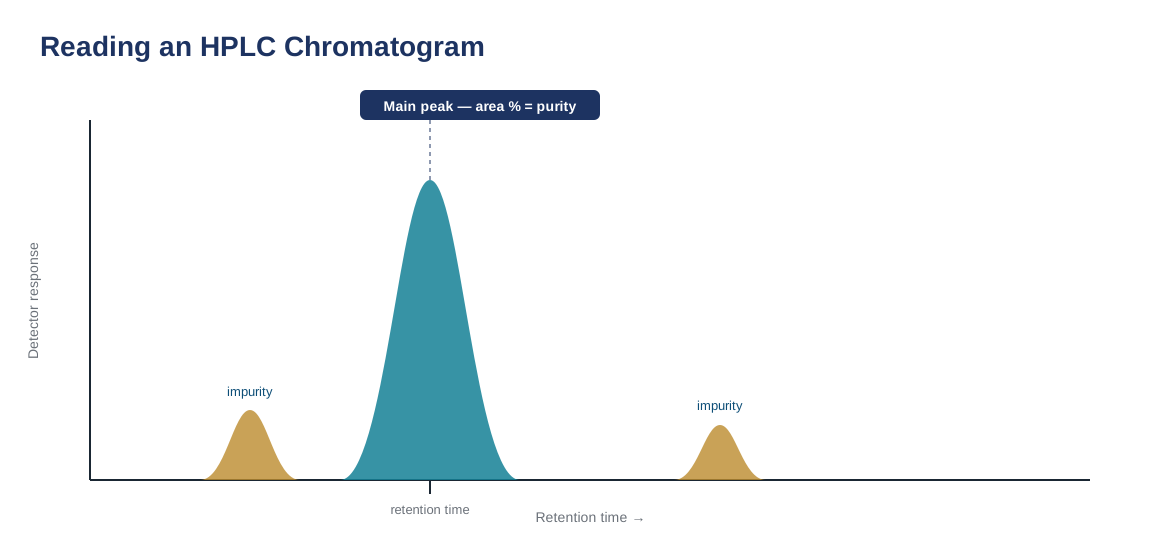
How a purity peak is read on an HPLC chromatogram.
Chromatographic separation, briefly
The quality of a purity result depends on how well the separation resolves the sample’s components. Poor separation can hide impurities under the main peak; good separation spreads components apart so each can be seen and measured. This is why the method behind a purity figure matters, and why HPLC — which offers high-resolution separation — is so widely used for purity assessment. The dedicated HPLC article covers how that separation works.
Interpretation limitations
A purity figure is powerful but bounded. It reflects what the method can detect, under the conditions used, for the sample injected. It does not report impurities that fall below the detection limit, nor those that co-elute with the main peak if separation is imperfect. And it says nothing about attributes outside its scope — sterility, endotoxins, heavy metals, or net quantity. High purity is genuinely good information; it is simply not the whole picture.
QUALITY NOTE — WHY HIGH PURITY IS NOT A FULL ANSWER
A 99% purity result answers one question well. It does not establish that a material is the correct compound (that is identity), that it is free of microbial or endotoxin contamination, or that heavy-metal levels are within limits. Each of those needs its own test.
How purity results appear on documentation
On a Certificate of Analysis, purity usually appears as a percentage with a stated method (commonly HPLC) and a specification such as “not less than 98.0%.” Read the value together with its unit and specification, note the method, and treat the figure as a well-defined answer to the purity question specifically — not as a summary verdict on the material as a whole.
Frequently asked questions
Usually that the main component accounts for about 99% of the total detector response (area percentage) under a specific method. It is a relative measure, not an absolute molecular count.
The area of the main component’s peak expressed as a percentage of the total area of all peaks in the chromatogram.
Yes. Impurities below the method’s detection limit, or that co-elute with the main peak when separation is imperfect, may not appear. This is why the method matters.
No. Purity is one attribute. It says nothing about identity, sterility, endotoxins, heavy metals, or quantity, each of which needs its own test.
Related articles
Glossary terms
Company standard
Continue learning
- Identity Testing Explained — the question purity assumes is already answered.
- Understanding HPLC — the separation method behind most purity results.
- Reading a Certificate of Analysis — how purity appears and how to read it.
- Heavy Metal Testing and Endotoxin Testing — attributes purity does not cover.
Research Use Only
All materials referenced are for laboratory research purposes only and are not for human or veterinary use. This article is educational and does not provide medical advice, dosing, or instructions for use.