
Home › Academy › Quality & Testing › Understanding LC-MS
Quality & Testing
Understanding LC-MS
Separation plus mass analysis: how liquid chromatography and mass spectrometry support identity.
Last updated: 2026-07-12 · ~8 minutes
On this page
If HPLC is the technique behind purity, LC-MS is often the technique behind identity. It combines separation with mass analysis to answer a question separation alone cannot: not just how many components are present, but what they are.
This article is conceptual and educational, explaining LC-MS in principle rather than as an operational procedure.
Key takeaways
- LC-MS combines liquid chromatography (separation) with mass spectrometry (mass analysis).
- The LC step separates a sample; the MS step measures mass-to-charge ratio (m/z).
- Mass information makes LC-MS well suited to supporting identity.
- A mass match supports identity strongly but does not prove it in isolation.
- LC-MS and HPLC share a separation stage; HPLC leans toward purity, LC-MS toward identity.
Two techniques, combined
LC-MS joins two methods into one workflow: liquid chromatography (LC) and mass spectrometry (MS). Liquid chromatography separates a sample into its components — the same separation principle behind HPLC. Mass spectrometry then analyzes those components by measuring a property closely tied to their molecular structure. The combination is more informative than either technique alone.
DEFINITION — LC-MS
A combined technique in which liquid chromatography separates a sample and a mass spectrometer analyzes the separated components by measuring their mass-to-charge ratio.
The liquid chromatography step
The LC portion works on the same basis described in the HPLC article: components are carried by a mobile phase through a column and separate according to how strongly they interact with the stationary phase. Separation matters here for a specific reason — analyzing a resolved single component gives cleaner information than analyzing a tangled mixture. LC delivers components to the mass spectrometer one at a time rather than all at once.
The mass spectrometry step
Mass spectrometry works by converting molecules into charged particles (ions) and measuring their mass-to-charge ratio — often written as m/z. Because that ratio relates directly to the mass of the molecule, MS yields molecular-mass information about each component. For a compound of known expected mass, a measured mass consistent with that expectation is meaningful evidence toward identity.
DEFINITION — MASS-TO-CHARGE RATIO (M/Z)
The ratio of an ion’s mass to its charge, measured by a mass spectrometer. It provides information about a molecule’s mass and, in turn, its identity.
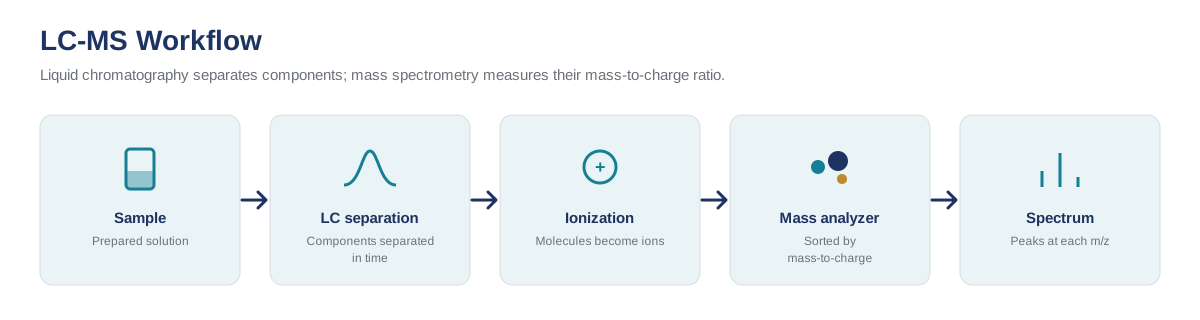
The LC-MS workflow, from sample to mass spectrum.
Why the methods are combined
Separation and mass analysis answer different halves of the same question. Chromatography sorts a mixture; mass spectrometry characterizes what has been sorted. Put together, LC-MS can take a real, mixed sample, separate it, and provide mass information on the components — which is why the technique is well suited to supporting identity. It brings together the “how much / how separated” strength of LC with the “what is it” strength of MS.
| Step | Contributes |
|---|---|
| Liquid chromatography (LC) | Separation of the sample into individual components. |
| Mass spectrometry (MS) | Molecular-mass information (via m/z) on each component. |
| Combined (LC-MS) | Mass information on separated components — strong support for identity. |
Identity applications
Because MS provides molecular-mass information, LC-MS is especially useful for questions of identity — confirming that a separated component has a mass consistent with the expected compound. For larger molecules such as peptides, this mass information is particularly informative. As always, identity is best built from several consistent observations rather than a single number, but a matching mass on a cleanly separated component is compelling evidence.
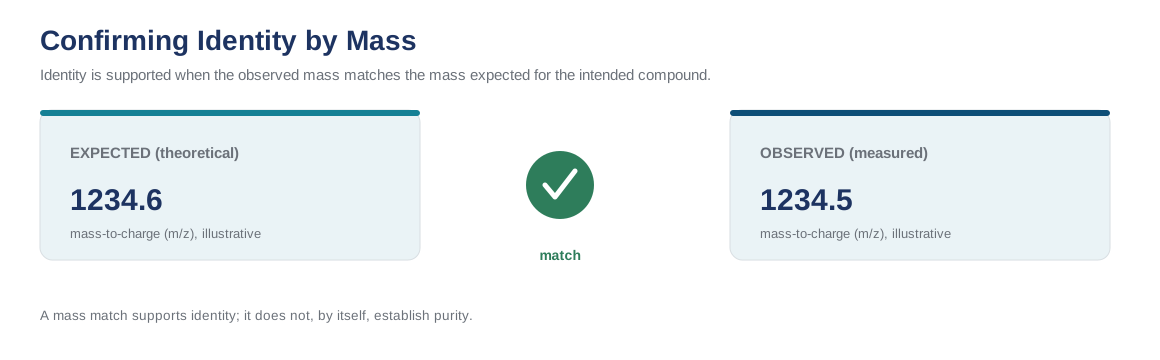
A match between expected and observed mass supports identity.
Limitations
LC-MS is not infallible. Different molecules can, in some cases, share a molecular mass, so a mass match supports identity rather than proving it absolutely. Ionization behavior varies between compounds, and, as with any method, results reflect what the instrument can detect under the conditions used. Interpreting LC-MS well means treating it as strong, but not solitary, evidence.
Relationship to HPLC
LC-MS and HPLC are relatives. The separation stage of LC-MS is chromatography of the same family as HPLC; the difference is what happens after separation. HPLC typically pairs separation with a detector suited to quantifying components (useful for purity), while LC-MS pairs separation with mass analysis (useful for identity). Read together, the two articles describe complementary strengths: HPLC leans toward purity, LC-MS toward identity, and both begin with separation.
Frequently asked questions
Liquid chromatography, which separates a sample into components, and mass spectrometry, which measures each component’s mass-to-charge ratio to give molecular-mass information.
The ratio of an ion’s mass to its charge, measured by the mass spectrometer. It relates to molecular mass and helps confirm identity.
Because mass information reflects molecular structure. A component that separates cleanly and shows a mass consistent with the expected compound is strong evidence toward identity.
Both begin with chromatographic separation. HPLC typically pairs separation with a detector for quantifying components (purity); LC-MS pairs it with mass analysis (identity).
Related articles
Company standard
Continue learning
- Understanding HPLC — the separation technique LC-MS builds on.
- Identity Testing Explained — the question LC-MS supports.
- Purity Testing Explained — the complementary strength of HPLC.
- Understanding COAs — how identity results are documented.
Research Use Only
All materials referenced are for laboratory research purposes only and are not for human or veterinary use. This article is educational and does not provide medical advice, dosing, or instructions for use.