
Home › Academy › Quality & Testing › Understanding Certificates of Analysis
Quality & Testing
Understanding Certificates of Analysis
What a COA is, what each section reports, and — just as important — what it cannot tell you.
Last updated: 2026-07-12 · ~10 minutes
On this page
- What a Certificate of Analysis is
- Why COAs matter
- Why documentation is batch-specific
- The typical sections of a COA
- Analytical methods referenced on a COA
- Reading the test results
- Traceability and batch numbers
- Laboratory information: who did the testing
- The limitations of a COA
- Supplier documentation beyond the COA
- How a COA fits into a larger quality system
A Certificate of Analysis, almost always shortened to COA, is the single most useful document a research-materials supplier can hand you. It is also one of the easiest to misread: it is tempting to glance at a purity figure near the top, see a high number, and assume the question of quality is settled. It is not. A COA answers several specific questions precisely and leaves several others untouched, and knowing which is which is what separates a careful evaluation from a hopeful one.
This guide explains what a COA actually is, walks through the sections you will typically find on one, and — just as importantly — sets out the limits of what a single document can establish. Everything here is written for laboratory and research contexts; it is educational, not a set of instructions for use.
Key takeaways
- A COA is a batch-specific record of analytical test results for one particular lot of material — not a general statement about a product line.
- It reports what was measured, the methods used, the results, and how those results compare against defined specifications.
- A COA is only as meaningful as its traceability: the batch or lot number on the document must match the material in your hand.
- A high purity result answers one question. It does not, by itself, establish sterility, endotoxin levels, heavy-metal content, or net quantity — those are separate tests.
- A COA documents a sample at a point in time. It is one part of a larger quality system, not a guarantee of every quality attribute.
What a Certificate of Analysis is
A Certificate of Analysis is a document that reports the results of analytical testing performed on a specific batch of material. Each entry on the certificate ties a measured property — identity, purity, quantity, and so on — to a result and, usually, to a specification the result is checked against. The word “certificate” can suggest something ceremonial, but a good COA is closer to a lab worksheet made presentable: a record of what was tested, how, and what was found.
DEFINITION — CERTIFICATE OF ANALYSIS (COA)
A batch-specific document reporting the analytical test results for a defined lot of material, typically including the tests performed, methods used, measured results, and the specifications those results are compared against.
Why COAs matter
In a market where descriptions can be vague and claims are easy to make, a COA moves the conversation from assertion to evidence. Rather than taking “high quality” on faith, a reader can see which properties were tested, what the results were, and whether they met a stated specification. That shift — from marketing language to documented measurement — is the entire point. It also lets different readers reach their own conclusions from the same data, which is how scientific evaluation is supposed to work.
A COA is equally valuable for what it makes visible when something is missing. If a certificate omits a test, reports a result without a specification, or cannot be tied to the batch in hand, those gaps are informative in their own right.
Why documentation is batch-specific
Two batches of the same material are not assumed to be identical. Small differences in synthesis, purification, handling, or storage can produce measurable differences between lots, which is why a COA is written for one batch rather than for a product in general. A certificate that applies to “the product” rather than to a specific lot is far weaker evidence than one tied to the batch you actually received.
DEFINITION — BATCH / LOT
A specific, traceable quantity of material produced or packaged together under the same conditions. A batch (or lot) number links physical material to its testing records.
The typical sections of a COA
Layouts vary between laboratories and suppliers, but most certificates contain the same core elements. The table below summarizes the sections you are most likely to see and the question each one answers.
| Section | What it answers |
|---|---|
| Product / material name | Which material this certificate describes. |
| Batch / lot number | Which specific production run it applies to. |
| Test date | When the analysis was performed. |
| Tests performed | Which properties were measured (identity, purity, etc.). |
| Method / instrument | How each property was measured (e.g., HPLC, MS). |
| Result | The measured value for each test. |
| Specification | The acceptance range or threshold the result is checked against. |
| Conclusion / disposition | Whether the batch met the specifications. |
| Laboratory identity | Who performed the testing. |
| Approval / signature | Who reviewed and released the results. |
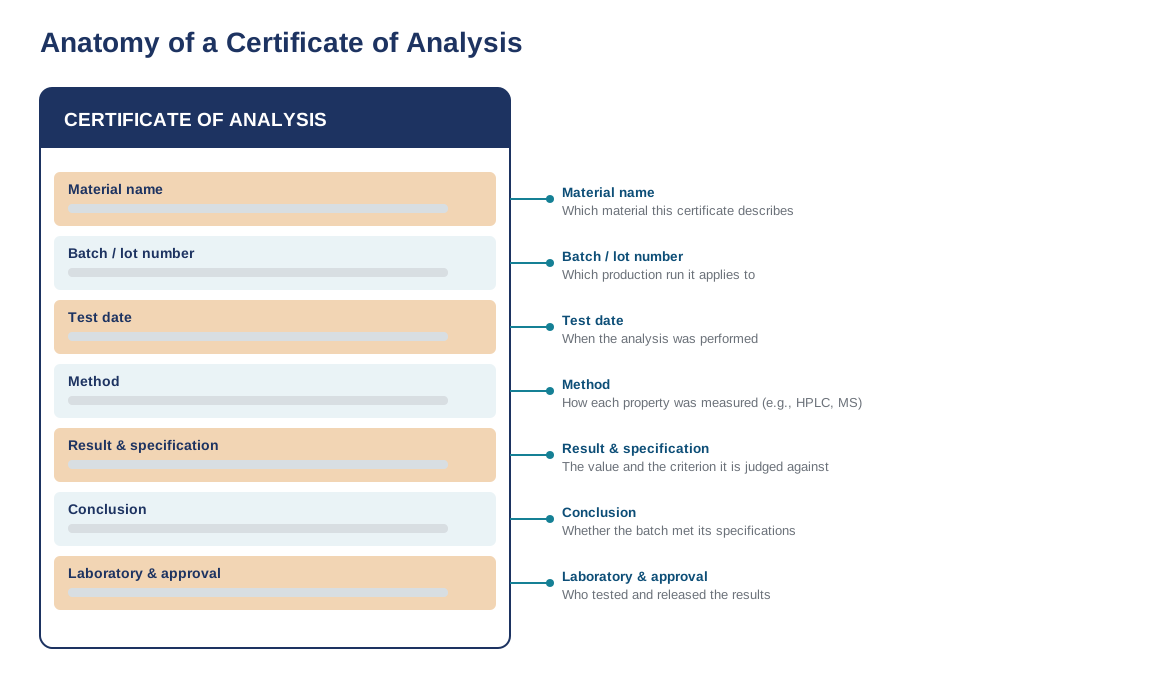
The parts of a Certificate of Analysis, labeled.
Analytical methods referenced on a COA
A result is only interpretable alongside the method that produced it, so a good COA names the technique used for each test. Two are especially common on certificates for research compounds. High-Performance Liquid Chromatography (HPLC) separates the components of a sample and is widely used to assess purity, often reported as an area percentage of the main peak. Mass spectrometry (MS) measures the mass-to-charge ratio of ions and supports identity by indicating whether the molecular mass matches the expected compound. These two are frequently paired: separation by HPLC, identification by MS. Deeper explanations of each live in their own Academy articles; here it is enough to know that the method gives the number its meaning.
RESEARCH NOTE — METHOD CONTEXT
The same property can be measured different ways, and results are not always directly comparable across methods. When comparing two COAs, check that like is being compared with like — the same test, measured the same way, against the same kind of specification.
Reading the test results
Each result should appear with three things: a value, a unit, and a specification. A value without a unit is ambiguous, and a value without a specification cannot be judged pass or fail — it is a number floating free of any standard. Purity is commonly given as a percentage; trace contaminants may be reported in parts per million (ppm) or parts per billion (ppb); quantity may be reported as a mass. Where a result sits relative to its specification is usually more informative than the raw figure alone.
DEFINITION — SPECIFICATION
The predefined acceptance criterion for a test — for example, “not less than 98.0%” or “not more than 10 ppm.” A result is judged by whether it falls within its specification.
Traceability and batch numbers
Traceability is what connects a piece of paper to a physical vial. The batch or lot number on the certificate should match the number on the material you received; if it does not, the COA describes some other batch and tells you little about the one in front of you. Reputable documentation makes this link easy to verify. Treat a mismatch, or an inability to match at all, as a meaningful gap rather than a formality.
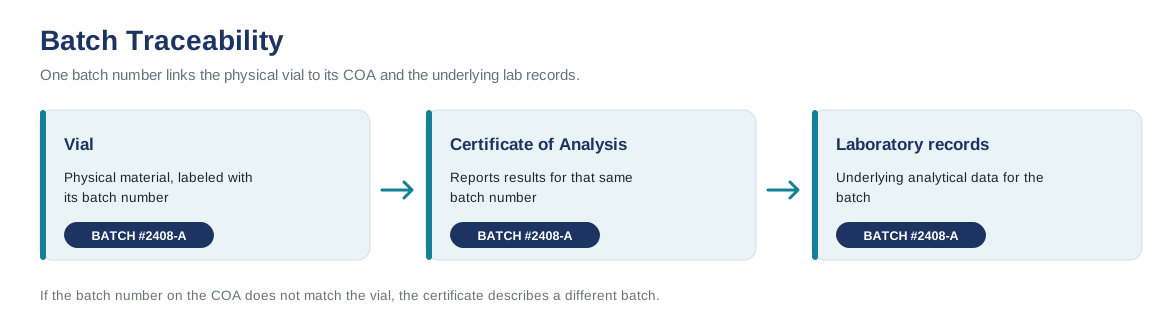
One batch number links the vial, its COA, and the laboratory records.
Laboratory information: who did the testing
A COA should identify the laboratory that performed the analysis. Testing can be done in-house by the manufacturer or by an independent third-party laboratory; both have a role, and each has limits. Independent testing adds an outside check, though it is only as strong as the sample it received and the chain of custody behind that sample. The identity of the laboratory, and whether it is independent, is part of what a reader weighs — not a detail to skip past. High Tide Compounds’ approach to independent testing is covered in its own article; specifics such as the testing laboratory and its accreditation are company facts that should be confirmed directly rather than assumed.
VERIFY WITH THE SUPPLIER
Named laboratories, accreditation status, and exact per-batch methods are supplier-specific facts. This article explains how to read a COA in general; for High Tide Compounds’ specific laboratories and accreditations, see the Independent Testing page. [CONFIRM WITH HIGH TIDE COMPOUNDS]
The limitations of a COA
This is the section most often skipped, and the most important. A COA reports the tests that were run — nothing more. A certificate showing excellent purity says nothing about sterility, endotoxin content, or heavy metals unless those tests also appear on it. Purity and identity are different questions; a compound can be highly pure and still not be what the label claims, or be correctly identified yet contain impurities. A COA also reflects the sample that was tested at the time it was tested; it is not a live guarantee that every unit is identical or that material has been handled correctly since. Reading a COA well means reading what is present and noticing what is absent.
QUALITY NOTE — WHAT A COA DOES NOT ESTABLISH
A single test answers a single question. High purity does not imply sterility; a correct identity does not imply purity; a clean heavy-metals result does not imply anything about endotoxins. Each attribute needs its own test, and the COA only speaks to the ones it lists.
Supplier documentation beyond the COA
A COA rarely travels alone. Depending on the material and supplier, it may sit alongside safety data, storage guidance, and batch records. These documents answer different questions — how to store and handle material, for instance, versus what a batch measured on testing. Treating the COA as one document within a set, rather than as a standalone verdict, gives a more complete picture.
How a COA fits into a larger quality system
A certificate is a snapshot; a quality system is the process that produces consistent snapshots batch after batch. At High Tide Compounds, the COA is one output of a broader program that spans sourcing, testing, documentation, and traceability. That program references a seven-point testing framework — Identity, Purity, Net Content, Endotoxin, Sterility, Heavy Metals, and Conformity — with the understanding that no single panel guarantees every aspect of quality; each point answers its own question. The COA is where the results of that testing become visible to the reader. Understanding the certificate, then, is the first step in understanding the system behind it.
Frequently asked questions
They overlap but are not identical. A lab report is the laboratory’s record of an analysis; a COA is the batch-specific certificate that presents those results against specifications for a defined lot. A COA is often derived from underlying lab data.
No. A COA documents the specific tests that were performed on a specific batch. It is strong evidence for the properties it reports and silent on properties it does not test. It is one part of a quality system, not a blanket guarantee.
Then the certificate describes a different batch and tells you little about the one you have. Matching the batch or lot number is what makes a COA meaningful; a mismatch is a gap worth resolving with the supplier.
Independent testing adds an outside check, which is valuable, but it is only as reliable as the sample tested and the chain of custody behind it. Both in-house and third-party testing have roles; the identity of the laboratory is one factor a reader weighs.
A COA should correspond to the batch you received, so the relevant question is batch match rather than calendar age. The test date tells you when that batch was analyzed.
Company standard
Continue learning
- Reading a Certificate of Analysis — a step-by-step walkthrough of verifying each field.
- Identity Testing Explained and Purity Testing Explained — the two questions most often confused.
- Third-Party Testing — what independent testing does and does not add.
- Seven-Point Quality Program — how the COA fits into the wider system.
Research Use Only
All materials referenced are for laboratory research purposes only and are not for human or veterinary use. This article is educational and does not provide medical advice, dosing, or instructions for use.