
Home › Academy › Quality & Testing › Third-Party Testing
Quality & Testing
Third-Party Testing
What independent testing adds, what it depends on, and why it is one pillar of quality — not the whole.
Last updated: 2026-07-12 · ~8 minutes
On this page
“Third-party tested” is one of the most common phrases in research-material marketing, and one of the most worth unpacking. Independence genuinely strengthens a result — but only in combination with a representative sample, a clear chain of custody, and a batch you can match.
This article is conceptual and educational, for laboratory and research contexts only.
Key takeaways
- Third-party testing is analysis by a laboratory independent of the maker or seller.
- Its value is independence; it complements, rather than replaces, in-house testing.
- A third-party result depends on a representative sample and a clear chain of custody.
- The report should match your batch by lot number and be traceable to the issuing lab.
- Independent testing is one pillar of a quality system, not the whole of it.
What independent third-party testing means
Third-party testing is analysis performed by a laboratory that is independent of the party that made or sells the material. The value of the arrangement is the independence itself: results come from an entity with no stake in the outcome. That separation is what distinguishes third-party testing from a manufacturer testing its own product.
DEFINITION — THIRD-PARTY TESTING
Analytical testing performed by an independent laboratory that did not manufacture or sell the material, providing results from a party without a stake in the outcome.
Manufacturer testing versus outside-laboratory testing
Both have a place. Manufacturer testing is often extensive and close to the process, with detailed knowledge of the material. Independent testing adds an outside vantage point and removes the conflict of interest inherent in grading one’s own work. The two are complementary rather than competing: in-house testing brings process knowledge; third-party testing brings independence. Neither alone is a complete quality system.
The benefits
- Independence: results do not depend on the seller’s own assessment.
- An outside check that can corroborate — or challenge — in-house findings.
- A shared, verifiable document that different readers can evaluate for themselves.
The limitations
Independence is powerful but not magic. A third-party result is only as good as the sample the laboratory received, the methods it used, and the integrity of the process that got the sample there. If the sample is not representative, or the chain linking it to the batch is unclear, independence does not rescue the result. Third-party testing strengthens confidence; it does not by itself guarantee quality.
Sample chain of custody
Chain of custody is the documented trail showing how a sample moved from the batch to the testing laboratory. It matters because a result is only meaningful if the sample tested genuinely represents the batch in question. Gaps in that trail weaken the link between the certificate and the material. The specific chain-of-custody and sampling process a supplier uses is a company-specific detail worth confirming directly.
VERIFY WITH THE SUPPLIER
How samples are drawn, handled, and transferred to an independent laboratory — the chain-of-custody process — is supplier-specific. For High Tide Compounds’ exact sampling and custody procedures, confirm directly. [CONFIRM WITH HIGH TIDE COMPOUNDS]
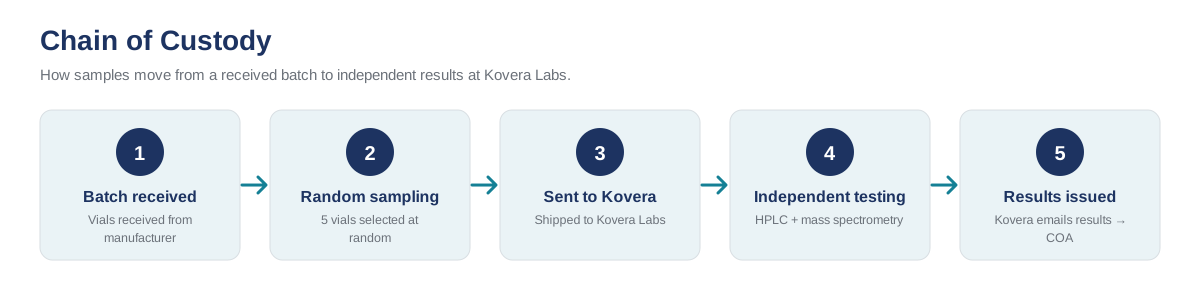
How samples move from a received batch to independent results.
Batch matching and report verification
Two practical checks make a third-party report useful. First, batch matching: the report should tie to the specific batch you received, by lot number, just as any COA should. Second, report verification: the report should be traceable back to the issuing laboratory rather than taken purely at face value. A report that cannot be matched to a batch, or traced to its source, offers less assurance than one that can.
Laboratory credentials
Not all laboratories are equivalent. Credentials such as accreditation speak to whether a laboratory operates under recognized quality standards. Credentials are part of how a reader weighs a third-party result — though, as with sampling, the specific laboratories and accreditations behind any given supplier’s testing are facts to confirm rather than assume.
Why third-party testing does not replace other quality systems
Independent testing is one pillar, not the whole structure. It does not substitute for sound sourcing, in-process controls, batch documentation, and traceability. A third-party COA showing good results is strong evidence for the properties it reports on the batch it describes — and it sits within a broader quality system rather than standing in for one.
Frequently asked questions
The testing laboratory is independent of the party that made or sells the material, so results come from an entity without a stake in the outcome.
It adds independence, which is valuable, but it depends on a representative sample and a clear chain of custody. In-house and third-party testing are complementary.
A result is only meaningful if the sample tested truly represents the batch. Chain of custody is the documented trail linking the sample to the batch.
No. It is strong evidence for the properties it reports on the batch it describes, within a broader quality system that also includes sourcing, controls, and documentation.
Related articles
Company standard
Continue learning
- Understanding COAs — how testing results become documentation.
- Reading a Certificate of Analysis — matching a report to your batch.
- Batch Consistency — why each batch is tested and recorded.
- Seven-Point Quality Program — the wider system testing fits into.
Research Use Only
All materials referenced are for laboratory research purposes only and are not for human or veterinary use. This article is educational and does not provide medical advice, dosing, or instructions for use.