
Home › Academy › Quality & Testing › Reading a Certificate of Analysis
Quality & Testing
Reading a Certificate of Analysis
A field-by-field walkthrough: what to check, in what order, and the warning signs to catch.
Last updated: 2026-07-12 · ~9 minutes
On this page
If Understanding Certificates of Analysis explains what a COA is, this article is the practical companion: how to actually read one. A certificate rewards a specific reading order, and following it turns a document that is easy to skim into one you can genuinely evaluate.
Everything here is written for laboratory and research contexts. It is educational — a way to interpret documentation — not a set of instructions for use.
Key takeaways
- Read the identifiers first: material name, batch/lot number, and test date must match before any result matters.
- Every result should carry a value, a unit, and a specification; a missing unit or specification is a red flag.
- The analytical method gives a result its meaning — look for it on each test.
- On a COA, absence is information: missing tests, methods, or specifications tell you something.
- Each test answers its own question; do not let one strong result stand in for the rest.
Start with the identifiers, not the numbers
The instinct is to jump to the purity figure. Resist it. The first job when reading a certificate is confirming that it describes the material in front of you — because a flawless result on the wrong batch is worthless. Read the top of the document before the middle.
Check three identifiers in order: the product or material name, the batch or lot number, and the test date. The name should match what you ordered. The batch number should match the number printed on your vial or packaging. The test date tells you when this batch was analyzed.
DEFINITION — BATCH / LOT MATCHING
Confirming that the batch or lot number on the COA is the same number found on the physical material. Without a match, the certificate is describing some other production run.
Verify the laboratory and the method
Next, find who performed the testing and how. A certificate should name the laboratory and, for each test, the analytical method or instrument used — for example, HPLC for purity or mass spectrometry for identity. The method matters because a result is only interpretable in light of how it was produced. A purity value with no stated method is a number without a context.
Note whether the laboratory is the manufacturer’s own or an independent third party. Neither is automatically superior, but the distinction is part of what you are weighing. Specific laboratory names and accreditations are supplier facts to confirm directly rather than assume.
Read each result as a trio: value, unit, specification
A well-formed result has three parts. The value is the measurement. The unit gives the value meaning — a bare “0.5” could be a percentage, ppm, or milligrams, and the difference is enormous. The specification is the acceptance criterion the result is checked against, such as “not less than 98.0%.” A result reported without a specification cannot be judged pass or fail; it is simply a number.
Where a result sits relative to its specification usually tells you more than the raw figure. A purity of 99.1% against a specification of “not less than 98.0%” passes comfortably; the same value against a stricter internal target might read differently. Read the comparison, not just the number.
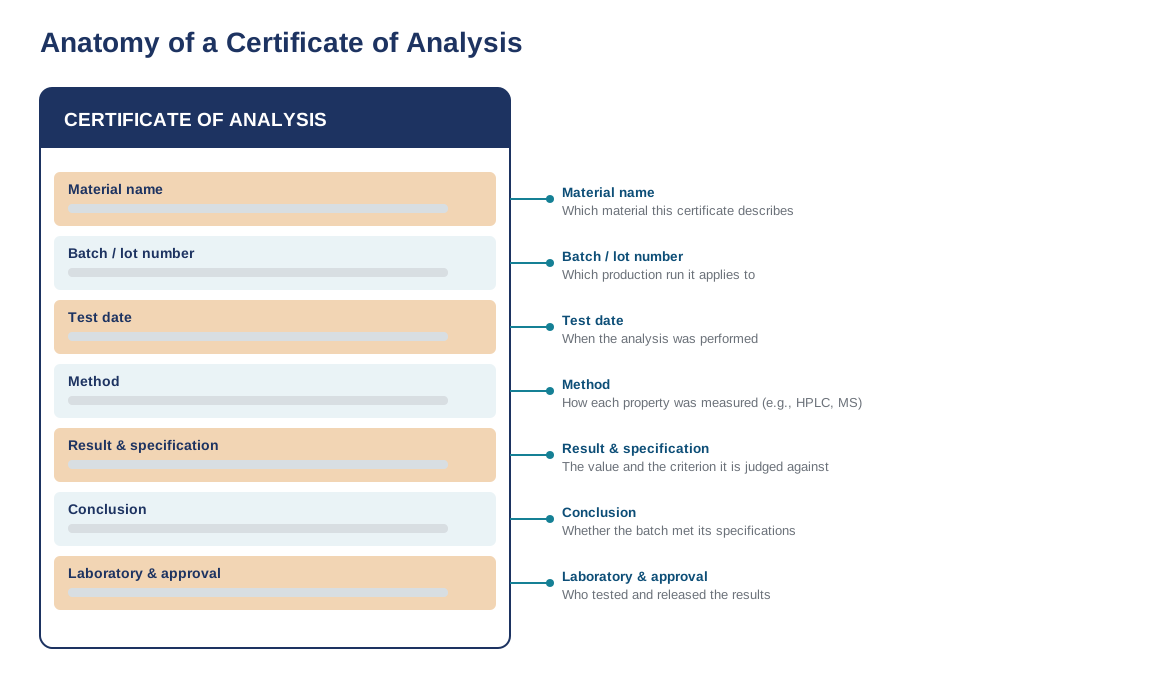
The parts of a Certificate of Analysis, labeled.
Look for approval, and for what is missing
Many certificates carry a signature or approval line indicating that a qualified person reviewed and released the results. Its presence signals a review step; its absence is worth noting. Equally important is scanning for gaps: a test listed with no result, a result with no specification, or an expected test that simply is not there. On a COA, absence is information.
Common interpretation mistakes
A handful of misreadings account for most confusion. The table below pairs each mistake with the correction.
| Common mistake | The correction |
|---|---|
| Reading purity as overall “quality” | Purity is one property; sterility, endotoxin, and heavy metals are separate tests. |
| Ignoring the batch number | A COA only applies to the batch it names; match it to your material. |
| Treating a value without a unit as meaningful | No unit means no interpretation; find the unit before concluding anything. |
| Assuming identity from a purity result | A pure sample can still be the wrong compound; identity is a distinct test. |
| Comparing results across different methods | Different methods are not always directly comparable; compare like with like. |
Warning signs
- The batch number on the COA does not match the material, or cannot be matched at all.
- Results appear without units, without specifications, or without a named method.
- The certificate refers to “the product” generally rather than a specific batch.
- Expected tests are absent, or the laboratory is not identified.
QUALITY NOTE — DIFFERENT RESULTS ANSWER DIFFERENT QUESTIONS
A single certificate can carry several tests, each answering its own question: identity (is it the right compound?), purity (how much is the main component?), and so on. Read each in isolation before forming an overall impression; do not let one strong result stand in for the others.
Putting it together
Reading a COA well is a sequence, not a glance: confirm the identifiers, verify the laboratory and methods, read each result as value-unit-specification, check for approval, and notice what is missing. Done in that order, a certificate stops being a reassuring number near the top and becomes what it should be — a piece of evidence you can actually evaluate.
Frequently asked questions
At the identifiers: the material name, the batch or lot number, and the test date. Confirm the batch number matches your material before reading any results.
It cannot be judged pass or fail. A value on its own is just a number; the specification is the standard that makes it meaningful.
It indicates a review-and-release step by a qualified person. Its presence is reassuring; its absence is worth noting, though layouts vary.
Only if the same test was run the same way against comparable specifications. Different methods are not always directly comparable, so compare like with like.
Related articles
Company standard
Continue learning
- Understanding Certificates of Analysis — the companion overview to this walkthrough.
- Identity Testing and Purity Testing — the two questions most often confused on a COA.
- Third-Party Testing — how to weigh the laboratory named on a certificate.
- Understanding HPLC — the method behind most purity results.
Research Use Only
All materials referenced are for laboratory research purposes only and are not for human or veterinary use. This article is educational and does not provide medical advice, dosing, or instructions for use.