
Home › Academy › Laboratory Practices › Analytical Methods Overview
Laboratory Practices
Analytical Methods Overview
The broad families of methods behind a COA — separation, mass-based, and beyond.
Last updated: 2026-07-12 · ~5 minutes
On this page
Every figure on a Certificate of Analysis is the product of an analytical method. Knowing the broad families of methods — without diving into operational detail — makes those figures much easier to read correctly.
This article is high-level and educational, for laboratory and research contexts only.
Key takeaways
- Analytical methods answer what a material is, how much is present, and what else it contains.
- Separation methods (like chromatography) pull a mixture into components.
- Mass-based methods (like mass spectrometry) characterize components by mass, supporting identity.
- Different questions call for different methods; a result means only what its method allows.
- A number is only interpretable alongside the method that produced it.
What analytical methods do
Analytical methods are the techniques used to answer questions about a material: what it is, how much of something is present, and what else it contains. Every result on a Certificate of Analysis is the output of an analytical method. Understanding the broad families of methods — without getting lost in operational detail — makes those results far easier to interpret.
Separation methods
One large family separates a mixture into its components so each can be examined. Chromatography is the archetype: as covered in the HPLC article, components are pulled apart based on how they interact with a stationary phase, producing a chromatogram of peaks. Separation is often the first step, because analyzing one component at a time is cleaner than analyzing a mixture.
Mass-based methods
A second family characterizes components by mass. Mass spectrometry measures the mass-to-charge ratio of ions, yielding molecular-mass information that supports identity — the basis of the LC-MS technique. Mass-based methods answer “what is it” in a way separation alone cannot, which is why the two are so often combined.
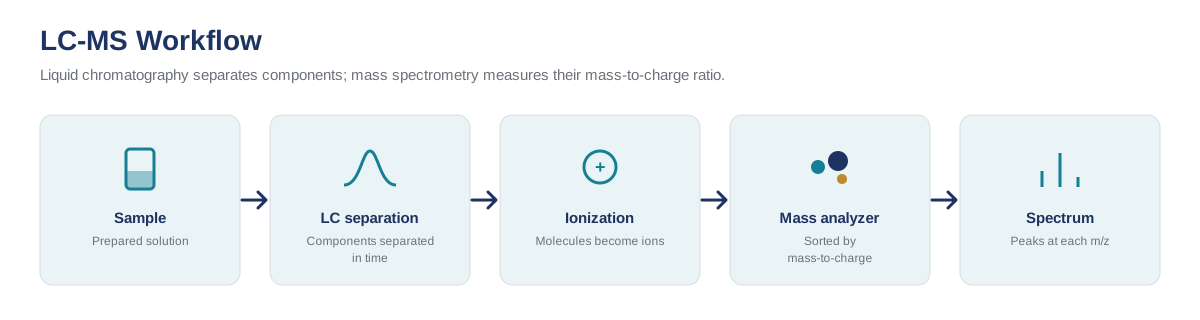
The LC-MS workflow, from sample to mass spectrum.
How methods relate to questions
The practical key is matching the method to the question. Different attributes call for different methods, and a result only means what its method allows it to mean. The table pairs common questions with the kind of method that addresses them; the Quality & Testing cluster covers each in depth.
| Question | Kind of method |
|---|---|
| How pure is it? | Separation (e.g., HPLC), reported as area percentage |
| Is it the right compound? | Mass-based (e.g., LC-MS) plus reference comparison |
| Are trace contaminants present? | Sensitive elemental or specific-analyte methods |
| Are viable organisms present? | Growth-based (sterility) methods |
Method context is everything
The recurring lesson across this Academy applies here too: a number is only interpretable alongside the method that produced it. The same property measured different ways may not be directly comparable, and every method has a detection limit and a set of assumptions. Good interpretation always reads the result and the method together.
Where to go deeper
This overview is a map; the Quality & Testing cluster is the territory. Understanding HPLC and Understanding LC-MS explain the two most common methods behind purity and identity, and the various testing articles explain what each method establishes and, importantly, what it does not.
Frequently asked questions
A technique used to answer a question about a material — its identity, purity, or contents. Every COA result is the output of one.
Separation methods pull a mixture into components (e.g., chromatography); mass-based methods characterize components by mass (e.g., mass spectrometry), supporting identity.
Because a number is only interpretable alongside the method that produced it; the same property measured differently may not be directly comparable.
Related articles
Company standard
Continue learning
- Understanding HPLC — the archetypal separation method.
- Understanding LC-MS — separation plus mass analysis.
- Purity Testing and Identity Testing — methods matched to questions.
- Reading a Certificate of Analysis — reading results with their methods.
Research Use Only
All materials referenced are for laboratory research purposes only and are not for human or veterinary use. This article is educational and does not provide medical advice, dosing, or instructions for use.